Production Traceability: The Quality Passport for the Global Supply Chain
In the dynamic industrial clusters of Saltillo and Monterrey, operational excellence is no longer measured solely by the volume of parts produced or the speed of the assembly lines. Today, the ability to reconstruct a product's complete history is an essential requirement for competing in international markets. When an automaker (OEM) or a large manufacturing plant detects a failure in the field, the first question it asks its Tier 1 and Tier 2 suppliers is: What is the exact genealogy of this component?
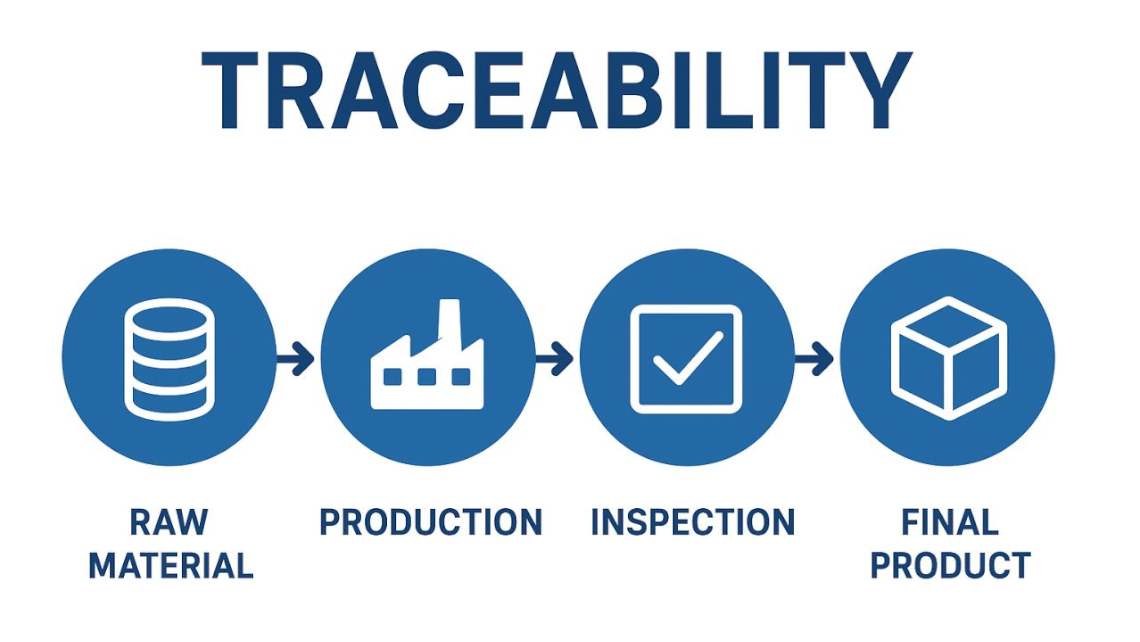
Production traceability is the system that records and identifies a product's path from the arrival of raw material at the warehouse, through each transformation station on the production floor, to its delivery to the end customer. In this detailed article, we look at how digitalization and Industry 4.0 have transformed traceability from a bureaucratic paper process into an automated, real-time competitive advantage.
The Two Axes of Industrial Traceability
A robust traceability system must cover the flow of information in two complementary directions:
- Backward (Upstream) Traceability: Identifies the origin of a product or lot. If a component fails on the shop floor, this axis helps trace which raw material lot it came from, which supplier provided it, which operator processed the part, and under which calibration or temperature parameters the machine was running at that moment.
- Forward (Downstream) Traceability: Locates where the products of a specific lot have been distributed. If the quality department detects that a lot of resin or steel arrived defective from the source, forward traceability immediately identifies which part numbers were made with that material and which shipments or customers they are with, enabling fast, selective containment.
Key Technologies for Implementing Digital Traceability
Leaving paper routing sheets and manual logbooks behind requires integrating capture hardware with custom management software:
1. Barcodes and Direct Part Marking (DPM)
Traditional barcodes, QR codes, and DataMatrix codes are the foundation of identification. In the automotive and metalworking industries, Direct Part Marking (DPM) is done by dot peen or laser engraving. This ensures the identification code remains permanently on the component throughout its service life, withstanding high temperatures or painting processes.
2. RFID (Radio Frequency Identification) Technology
Unlike visual codes, RFID labels or tags can be read without a direct line of sight. By placing RFID antennas at warehouse entrances or critical assembly line stations, the system records the passage of containers, pallets, or entire racks in bulk and automatically, speeding up logistics flows.
3. Mobile Apps and Handheld Scanners
Equipping receiving, picking, and assembly operators with mobile apps on tablets or handheld terminals ensures that every physical movement of material is accompanied by a digital validation. The software prevents an operator from using the wrong raw material or one that hasn't passed the prior quality inspection.
4. MES and ERP System Integration
Scan data must be centralized. Custom manufacturing execution software (MES) collects data from the production floor (serial numbers, cycle times, torque measurements, leak tests) and links it directly to work orders and financial data in the corporate ERP system.
Critical Benefits for the Automotive and Manufacturing Sectors
- Mitigating Product Recall Costs: If a quality claim occurs, digital traceability makes it possible to isolate the problem to a handful of specific serial numbers instead of recalling an entire month's production. This saves millions of pesos and protects the company's reputation.
- IATF 16949 Compliance: This demanding international automotive certification requires strict traceability controls. An automated digital system simplifies certification audits by delivering genealogy reports in seconds.
- Optimized Quality Control: By correlating traceability data with the scrap generated, process engineers can uncover hidden patterns, such as recurring failures when a specific material lot is used or when a machine runs on a particular shift.
Conclusion
Production traceability is no longer just a customer requirement; it has become a tool for internal protection and optimization. By digitizing the trail of your components, you turn quality control into a transparent process, raise your company's institutional standing, and earn the trust needed to secure high-value projects in the advanced manufacturing supply chain.
Would your traceability system survive a surprise automotive audit?
Protect your operation and give your customers certainty. At LT CODER we develop Custom Software, Mobile App, and Systems Integration solutions to automate end-to-end traceability in plants in Saltillo and Monterrey. We connect your barcodes, RFID, and processes so you have complete visibility in seconds.
Talk to a specialist and safeguard your production floor today