INDUSTRIAL DATA ARCHITECTURE AND INDUSTRY 4.0
PLC, SCADA, and ERP Integration: The Definitive Guide to Connecting the Production Floor with Corporate Management
Discover how to break down the barriers between OT and IT to build a truly smart, automated, and profitable plant in the modern manufacturing environment.
Introduction: The Great Gap between the Shop Floor and the Boardroom
In today's industrial ecosystem — especially in the dynamic manufacturing and automotive clusters of regions such as Saltillo and Monterrey — there is a dilemma that has haunted executives for decades. On one side, the production floor generates gigabytes of data per second through sensors, variable frequency drives, servomotors, and programmable logic controllers (PLCs). On the other, senior management operates based on enterprise resource planning (ERP), analyzing costs, purchase orders, inventory levels, and profit margins.
Historically, these two worlds have existed in parallel, disconnected universes. Operational technology (OT), responsible for running the machines and keeping the lines operating at the required cadence, has been managed through SCADA (Supervisory Control and Data Acquisition) systems. Meanwhile, information technology (IT) has focused on finance, corporate logistics, and customer relationships. The disconnect between OT and IT creates a "gray zone" in which critical plant data dies on the shop floor or requires an army of engineers and administrators to be entered manually into spreadsheets.
PLC, SCADA, and ERP integration is the backbone of Industry 4.0. It's not simply a matter of running a network cable between the machinery and the central server; it's about designing an integrated data architecture that turns the microseconds of industrial physics into executive financial decisions in real time. In this complete guide, we take an in-depth look at what this integration involves, its architectural challenges, the technologies involved, and its direct impact on the profitability of advanced manufacturing plants.
1. Understanding the Traditional Automation Pyramid (and Its Evolution)
To understand how these systems connect, we first need to look at the ISA-95 reference model, traditionally known as the Industrial Automation Pyramid. This model divides operations into five hierarchical levels:
- Level 0 (Process): The physical assets on the shop floor, including field instruments, actuators, valves, photoelectric sensors, temperature transmitters, and motors.
- Level 1 (Control): The immediate operational brains, represented by PLCs (Programmable Logic Controllers) and PACs (Programmable Automation Controllers), which execute control logic in real time (milliseconds) to regulate the machines.
- Level 2 (Supervision): HMI (Human-Machine Interface) and SCADA systems, responsible for on-site visualization, local alarm management, and short-term process data collection.
- Level 3 (Operations Management / MES): Manufacturing Execution Systems (MES), which orchestrate production flow, control quality, manage lot traceability, and measure OEE (Overall Equipment Effectiveness).
- Level 4 (Business Planning / ERP): Corporate software (such as SAP, Oracle, or Microsoft Dynamics) that manages financial resources, purchasing, billing, and customer orders on a global scale.
Breaking the Hierarchical Model
The problem with the traditional pyramid model is that information had to climb slowly, level by level. If a PLC at Level 1 detected a recurring quality failure, the information had to pass to SCADA, then to MES, and finally be processed by the ERP hours or days later. In modern manufacturing, the pyramid is turning into an interconnected matrix network, where data from any level can flow bidirectionally and securely to whichever layer needs it, thanks to open protocols and cloud infrastructure.
2. Definition and Roles of the Components in the Integrated Ecosystem
A. The PLC (Programmable Logic Controller)
The PLC is the workhorse of the manufacturing floor. Its sole and crucial responsibility is to guarantee deterministic process control in milliseconds. Designed to tolerate the harsh conditions of the industrial environment (electromagnetic interference, dust, humidity, and vibration), the PLC processes inputs from the machine's sensors and executes immediate actions through its outputs. In the context of integration, the PLC is the primary source of physical truth.
B. The SCADA System
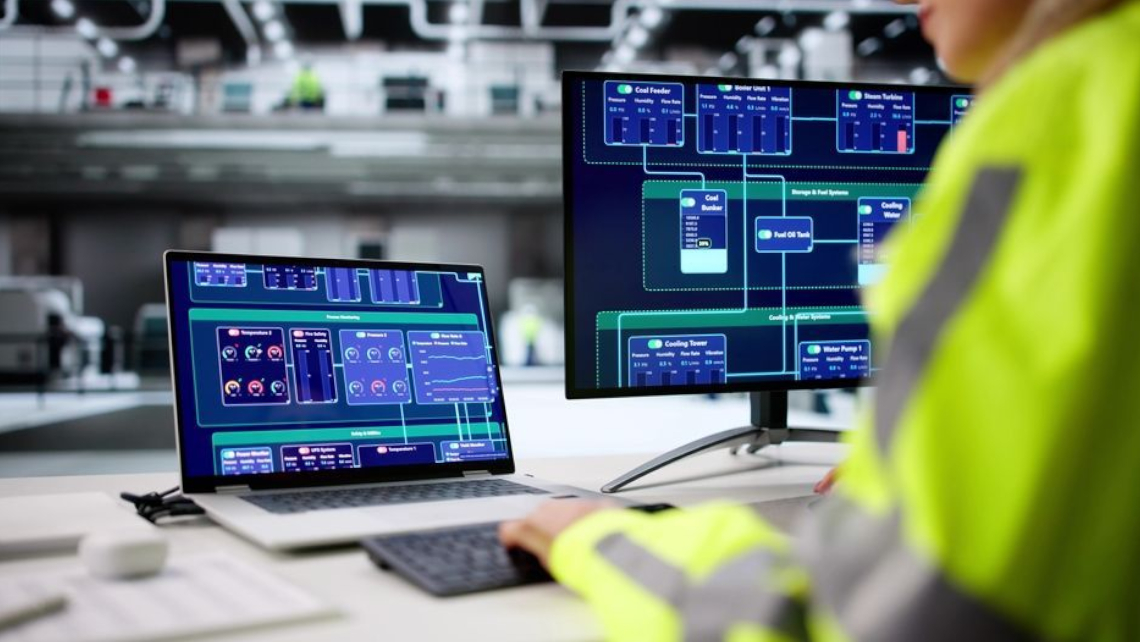
The SCADA system aggregates information from multiple PLCs and field devices distributed throughout the industrial building. Its main function is to give operators and engineers an interconnected graphical representation of the plant's status. SCADA doesn't just display real-time states; it also records historical trends of variables (temperatures, pressures, speeds) and manages safety alerts and operational stoppages.
C. The ERP System
The ERP is the corporation's administrative brain. It doesn't know (or need to know) how many revolutions per minute a specific motor on line 3 is turning; what the ERP needs to know is how many finished components are available for shipment, what the energy cost per unit produced was, and how much raw material is left in the warehouse to reorder from suppliers.
The Meeting Point
PLC, SCADA, and ERP integration consists of creating a constant flow in which activity detected by the PLCs and consolidated by SCADA automatically updates inventory and work orders in the ERP, while production orders released from the ERP immediately configure recipes and parameters on the shop floor.
3. Technologies and Protocols That Make Integration Possible
One of the biggest historical obstacles in industrial automation projects has been the "Tower of Babel" of communication protocols. Each machinery manufacturer (Allen-Bradley/Rockwell, Siemens, Omron, Mitsubishi, Schneider Electric) historically used proprietary networks and languages. To achieve successful convergence between PLC, SCADA, and ERP, you need to rely on open communication standards:
1. OPC UA (Open Platform Communications Unified Architecture)
OPC UA is today the irreplaceable gold standard of Industry 4.0. Unlike its predecessor (OPC Classic), OPC UA is a cross-platform, service-oriented, and highly secure architecture. It allows devices from different brands to understand each other directly and lets industrial servers send modeled data directly to software applications in the cloud or on local servers without requiring complex middleware.
2. MQTT (Message Queuing Telemetry Transport) and Sparkplug B
Originally designed for environments with limited bandwidth, MQTT has become the protocol of choice for the Industrial Internet of Things (IIoT). Using an extremely lightweight Publisher/Subscriber (Pub/Sub) architecture model, it allows sensors and PLCs to send data by exception (only when a variable changes), drastically reducing network load compared with traditional polling. The Sparkplug B profile adds the data type definitions and state management required for the industrial environment.
3. Intermediate Databases (SQL / NoSQL) and Data Gateways
Because ERPs and industrial systems operate at different speeds and with different architectures, relational databases such as Microsoft SQL Server, PostgreSQL, or MySQL often act as high-speed buffers. Data connectors or Gateways read variables from the OPC UA server, structure them into SQL tables, and allow the ERP to query them through secure transactions or stored procedure calls.
4. RESTful APIs and Web Services
To connect middleware or the SCADA system to modern cloud-hosted ERP systems (such as SAP S/4HANA Cloud or Microsoft Dynamics 365), web-based application programming interfaces (APIs) (REST / JSON) are used. This allows production events to be sent asynchronously and securely using HTTPS/TLS encryption.
4. Practical Use Cases: What Do You Achieve by Connecting PLC, SCADA, and ERP?
Beyond the technical definitions, the real value of integration is shown in its direct impact on production floor processes and executive decision-making. Below, we look at four key use cases:
A. Automatic Real-Time OEE (Overall Equipment Effectiveness) Calculation
OEE is the fundamental indicator of industrial productivity, calculated by multiplying Availability, Performance, and Quality. When the system isn't integrated, OEE data is collected on paper sheets where operators manually write down the causes of stoppages.
With full integration: The PLC detects the machine stop instantly. SCADA records the duration of the stoppage and prompts the operator on screen to categorize the event. The count of good and scrap parts generated by the sensors is cross-referenced in real time with the product's design speed (obtained from the ERP). The result is a 100% automated, accurate OEE panel available in real time to plant managers and corporate executives.
B. Component Traceability and Product Genealogy (IATF 16949)
In the automotive and advanced manufacturing sectors, traceability isn't optional. A customer may need to know exactly on what date, with which raw material lot, and under which torque or curing temperature values a specific component was manufactured.
With full integration: When a raw material lot enters the warehouse, it is recorded in the ERP. When it enters the production line, the work order is downloaded to SCADA. As the product passes through each work cell, the PLCs record the physical variables (stamping pressure, cycle times, leak test results) and link them directly to the component's unique serial number. If the product fails in the field months later, the ERP allows a backward analysis (upstream traceability) in seconds to isolate the affected lot without the need for a massive recall.
C. Real-Time Inventory Consumption (Automatic Backflushing)
In traditional plants, raw material theoretically "disappears" from the ERP inventory based on estimates or end-of-shift reviews. This causes serious inventory accuracy (IRA) discrepancies, surprises in cycle counts, and unexpected stockouts that stop the lines.
With full integration: Every time a PLC completes the assembly of a part and the output sensor counts it, the system sends an automatic signal to the ERP to perform instant "backflushing." The ERP deducts the exact inputs (screws, resins, electronic components) from the system according to the bill of materials (BOM) assigned to the order, keeping inventory up to the second and triggering automated Just-In-Time purchasing.
D. Condition-Based Maintenance and Asset Management
Preventive maintenance based purely on a fixed-date calendar is inefficient: it's either done too early, wasting resources, or too late, causing unexpected failures.
With full integration: Sensors connected to the PLC record variables such as actual motor operating hours, current draw, and vibration readings. SCADA analyzes these trends and, as soon as preset tolerance thresholds are exceeded, sends an automatic Work Order directly to the ERP's maintenance module (EAM/CMMS). The maintenance team receives the notification on their mobile devices and reserves the required spare parts in the warehouse before the machine suffers a catastrophic breakdown.
5. Integration Challenges and Cybersecurity (IT/OT Convergence)
Despite its undeniable benefits, connecting the corporate world with the industrial floor presents technical and organizational challenges that must be addressed from the project's design phase:
A. The Cultural Gap between IT and OT
OT engineers prioritize availability and determinism: a machine can't tolerate a 10-millisecond pause in its network cycle, nor can it be rebooted mid-shift to apply an operating system patch. IT administrators, for their part, prioritize corporate confidentiality, data integrity, and cybersecurity.
For integration to succeed, the organization must establish multidisciplinary project teams in which both approaches are respected and combined, creating shared governance policies.
B. Industrial Cybersecurity and the IEC 62443 Standard
Connecting PLCs and SCADA to the company network — and potentially to the cloud — opens attack vectors that didn't exist when plant networks were isolated (air-gapped). Malware that enters through a phishing email in the accounting department could, in theory, spread to the factory's control network if there are no adequate physical and logical barriers.
To mitigate this risk, modern architectures should follow the guidelines of the IEC 62443 industrial cybersecurity standard and implement the zones-and-conduits model using the Purdue Network Architecture:
- Network Segmentation (VLANs): Isolate industrial control broadcast traffic from corporate web traffic.
- Industrial Demilitarized Zone (IDMZ): Place a robust firewall between the IT network and the OT network. No PLC or SCADA system should communicate directly with the ERP; all data exchange must go through secure intermediary servers located within the IDMZ.
- Access Control and Encryption: Use individual passwords per profile, disable unused physical network ports on the operating floor, and enforce encrypted protocols (such as OPC UA with X.509 security certificates).
6. Roadmap: Step by Step to a Successful Integration
Implementing an integration project of this magnitude can seem overwhelming. The key is to move forward with a phased strategy, minimizing operational risk and securing a return on investment (ROI) at each stage:
- Phase 1: Field Audit and Asset Assessment: Identify the existing infrastructure in the plant. Which PLC brands and models run on the lines? Do they have Ethernet communication cards or obsolete networks? Which version of SCADA or HMI is used? Is the shop floor network structured, or is it made up of temporary patches?
- Phase 2: Data Normalization and Information Model: Before sending data to the ERP, define naming standards. A variable can't be called "Temp_M1" on line A and "Temperatura_Zona1" on line B. Implement a structured data model based on standards such as OPC UA or ISA-95.
- Phase 3: Pilot Project on a Critical Line: Don't try to digitize and connect the entire factory in one go. Select a representative production line or the plant's most costly bottleneck. Implement connectivity from the PLCs to a test intermediary server and connect it to a specific ERP module (for example, production recording).
- Phase 4: Results Evaluation and Adjustment: Measure the pilot's performance over a set period. Were manual data-entry errors reduced? Did the response time to stoppages improve? Did the industrial network remain stable without critical latency? Adjust the architecture based on what you learn.
- Phase 5: Progressive Scaling and General Rollout: Replicate the proven solution across the remaining lines and industrial buildings, gradually integrating more complex modules such as automatic maintenance management, statistical process control (SPC), and predictive analytics.
7. Comparison Table: Traditional Integration Methods vs. the Modern 4.0 Approach
To clearly visualize the technological transformation, the following table contrasts the old patch-based integration model with the modern model based on open standards:
| Feature | Traditional Method (Silos and Hybrid) | Modern Industry 4.0 Approach |
|---|---|---|
| Data Capture | Manual on paper and Excel sheets re-entered at the end of the shift. | Automated directly from sensors and PLCs in real time. |
| Network Protocols | Brand-specific proprietary protocols requiring costly, dedicated drivers. | Open, interoperable standards (OPC UA, MQTT, REST APIs). |
| ERP Synchronization | Batch or deferred (overnight processing of CSV or TXT files). | Bidirectional, immediate, and driven by transactional events. |
| KPI Visibility | Static historical reports delayed by days or weeks. | Live interactive dashboards visible on the floor, on the web, and on mobile devices. |
| Cybersecurity | Trust based on an illusory physical isolation ("air gap"). | Layered segmentation (IEC 62443), end-to-end encryption, and IDMZ firewalls. |
| IT Maintenance Cost | High; multiple fragile custom connectors that break when systems are updated. | Low; scalable modular architectures backed by industrial standards. |
8. Conclusion: The Future Belongs to Interconnected Plants
Integration between PLC, SCADA, and ERP is no longer an optional technological advantage or a project reserved exclusively for the industry's global giants. Today, it is an essential survival requirement for any manufacturing company that aims to remain competitive in the international supply chain.
Connecting the production floor with financial management eliminates the hidden costs of inefficiency: hours lost re-entering data, decisions made on outdated numbers, excessive scrap due to a lack of early warnings, and the inability to respond nimbly to market changes. By turning existing physical infrastructure into a continuous source of strategic knowledge, organizations make their assets the ultimate engine of growth, innovation, and operational excellence.
Ready to connect your plant's machines with your business intelligence?
At LT CODER we specialize in developing Custom Software, Industrial Connectivity (PLC/SCADA), ERP System Integration, and Real-Time Dashboards for the manufacturing and automotive industries in the Saltillo and Monterrey regions. We help your team design and implement a secure, modern data architecture with high operational impact.
Talk to an industrial integration consultant and schedule a technical visit to your plant